

Capital Optimisation Under the Basel III Endgame

Summary
Basel III endgame reforms are changing capital optimisation across all major jurisdictions. We are now seeing a push towards greater reliance on standardised approaches; this makes capital an increasingly structural constraint on growth and returns. The reforms demonstrate a significant shift away from technical modelling. With implementation of these reforms already underway in the EU, partly in the US and fast approaching in the UK, institutions that adapt early can still position their capital efficiently. Those relying on legacy optimisation techniques are at significant risk of locking in inefficiencies in the long term.
Under Basel II and early Basel III, banks were able to use their internal models to optimise risk-weighted assets (RWAs) and improve capital efficiency. Post-financial crisis reforms later reduced the level of discretion allowed for such modelling, instead strengthening the resilience of financial institutions through higher quality capital, leverage constraints and tighter supervisory standards. The Basel III endgame represents the final phase of this shift, limiting model-driven outcomes and fostering greater reliance on standardised approaches to capital optimisation.
The significance of Basel III endgame today
Historically, capital optimisation was focused on technical calibration. Enhancements to internal models and parameters could generate meaningful reductions in RWAs with limited changes to the underlying business.
Today, Basel III is embedded as the baseline prudential framework and its impact is largely structural. Output floors, tighter model eligibility and binding leverage constraints materially affect capital requirements, returns and business model viability. Optimisation has become less about technical modelling and more about strategic balance sheet, pricing and portfolio decisions.
The endgame reforms materially restrict discretion with stronger regulatory control over capital outcomes. Output floors cap the benefit of internal models relative to the standardised approach. Parameter floors and narrower eligibility make modelling less flexible. Leverage ratios and stress testing introduce additional non risk-based constraints that can bind even where RWAs are optimised.
In practice, many legacy optimisation techniques no longer deliver the same returns. For many institutions, capital considerations started to shape their strategy well before the relevant implementation dates.
Regional implications in practice
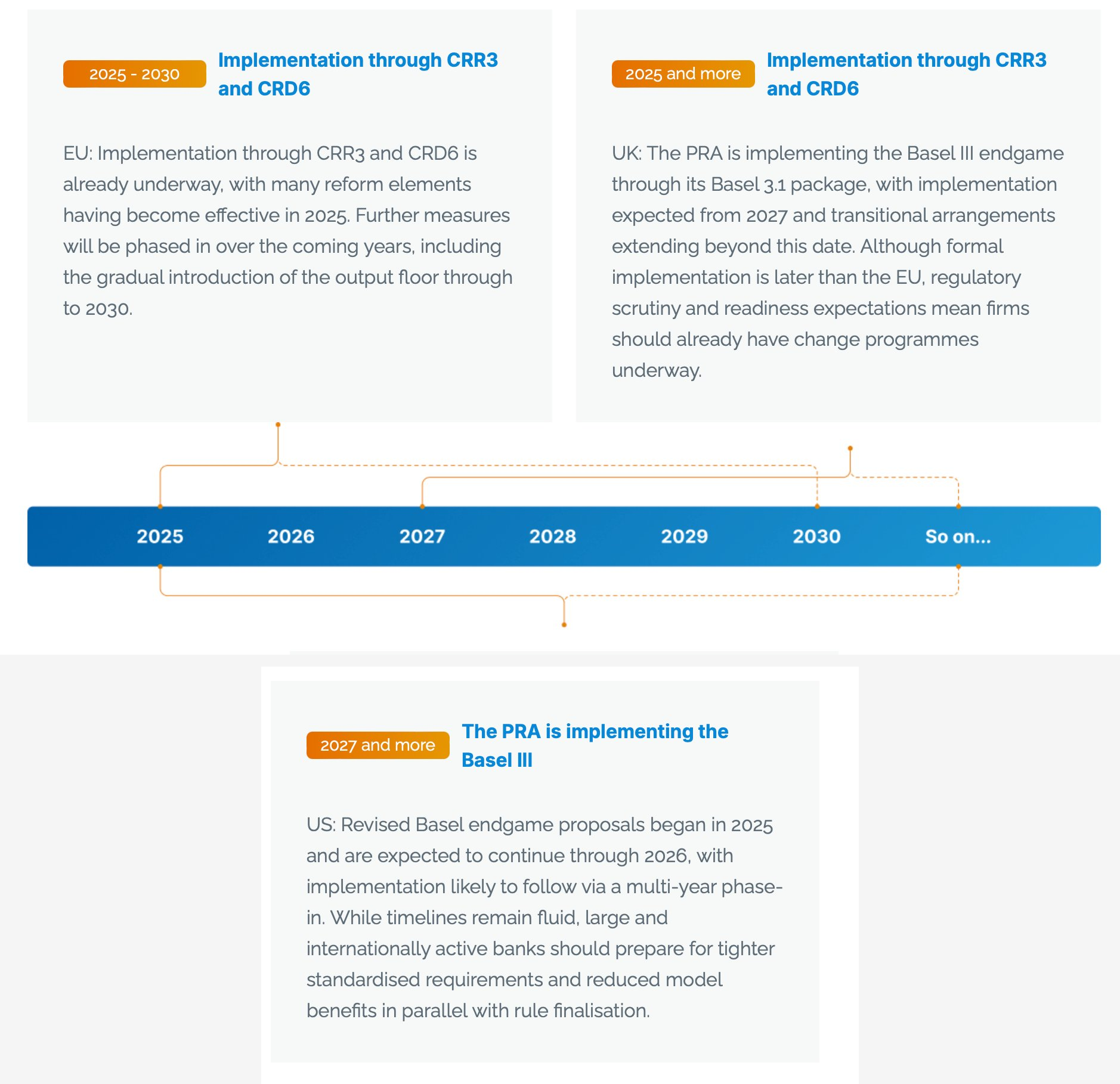
While there is a clear global trajectory for the reforms, timing and supervisory emphasis differ across jurisdictions. Understanding these differences is critical for international firms.
-
The PRA’s Basel 3.1 framework is expected to take effect from 2027. While this provides some time, firms should expect regulator supervision to intensify well ahead of go-live.
For larger and more complex banks, tighter modelling standards, increasing scrutiny and the progressive binding of output floors are already limiting the scope for model-driven capital relief. Alongside this, leverage ratios and stress testing often act as independent constraints.
In practice, many UK banks are already moving optimisation efforts away from model refinement in favour of portfolio composition, pricing discipline, data quality and stronger governance.
-
Core CRR3/CRD6 reforms have applied since 2025, meaning that for many EU banks, focus has already shifted from planning to active delivery and remediation. The standardised approach to optimisation is now increasingly driving capital outcomes. Supervisory expectations around data quality, reporting consistency and governance are also intensifying.
Optimisation efforts in the EU demonstrate a focus on accurate exposure classification, collateral recognition and integrated capital planning, rather than technical modelling. For EU institutions, the aim now is less to do with preparation and more about active delivery.
-
US regulators have proposed reforms that similarly deter reliance on internal models and strengthen standardised capital requirements for large banks. While final rules and timelines are still evolving, revised proposals are expected in the near term, with implementation likely to follow on a phased basis over several years.
Capital optimisation in today’s landscape
Capital optimisation is now a strategic decision-making exercise.
Banks must primarily focus on balance sheet and portfolio choices, actively managing capital-intensive exposures, rebalancing toward assets with more favourable risk weights, and making informed decisions on run-off, disposals, or risk transfer. Capital efficiency is now determined by what sits on the balance sheet rather than how it is measured.
Pricing discipline is equally critical. Embedding capital consumption into product design and client-level profitability ensures scarce capital is allocated to activities that generate sustainable returns.
As output floors bind, the standardised approach becomes a primary driver of capital outcomes. Data quality, exposure classification, and collateral recognition therefore become practical optimisation levers. Improvements in these areas can boost efficiency without heightened risk.
Capital structure, funding strategy, and operating model maturity also play a growing role. Active management of CET1, AT1, and Tier 2 instruments, alignment with leverage and liquidity constraints, and robust end-to-end capital processes are now integral to sustainable optimisation.
What firms should be aware of
Structural capital increasingly driven by output floors and leverage constraints
Hidden capital inflation from data gaps, poor classifications, or overly conservative assumptions
Misalignment between business strategy, growth plans, and capital consumption
Heightened supervisory scrutiny on governance, transparency, and auditability
Tighter integration between capital planning, stress testing, and recovery and resolution frameworks
Conclusion
The Basel III endgame reshapes how banks compete and grow. Capital is no longer a technical metric to be optimised at the margins, but a binding strategic constraint that directly influences portfolio choices, pricing, and long-term business model viability. With implementation already underway in some regions and approaching rapidly in others, early action is critical. Institutions that strengthen balance sheet discipline, data quality, and integrated decision making now will be better positioned to deploy capital efficiently, while those that delay risk being constrained both competitively and strategically.